Broker Check

Our November 2025 Newsletter: Medicare 101

November 07, 2025

Medicare 101

Medicare is a federal health insurance program for those 65 or older, or younger with certain disabilities. The initial enrollment period starts 3 months before the month you turn 65 and lasts for 3 months afterward.

The Medicare program is divided into 4 parts (Parts A, B, C, & D) that each cover different services:

Part A(Hospital Insurance, which helps cover inpatient care in hospitals, skilled nursing care for up to 100 days, and hospice care)

The monthly premium is $0 for most people because Medicare taxes were paid for at least 10 years while working.

If you don’t qualify for premium-free Part A, you are able to pay a monthly premium for coverage.

Part B(Medical Insurance, which helps cover doctor’s visits, lab tests, diagnostic screenings, preventative care, medical equipment, ambulance transportation, and other outpatient services)

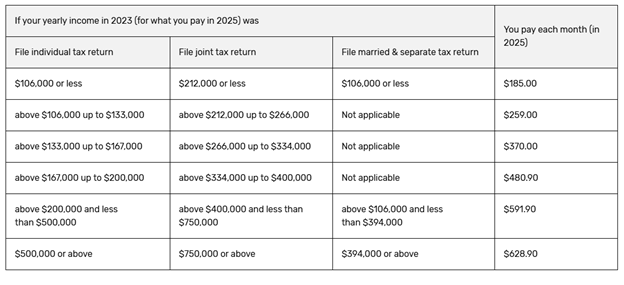
The monthly premiums range depending on your income. The standard monthly premium is $185/month, however, you will pay a higher premium based your modified adjusted gross income (MAGI), as reported on your IRS tax return from 2 years ago. 

If you are already receiving Social Security benefits, the monthly premium is deducted from your monthly benefit payment.* If not, Medicare will bill you quarterly or you can set up electronic payments.

If you do not sign up for Medicare when you are first eligible, you may have to pay a late enrollment penalty. The Part B late enrollment penalty adds 10% to the standard Part B premium for each full 12 month period when you should have had Part B but didn’t and this penalty lasts for your lifetime.

You may be able to delay signing up for Medicare, and avoid the late enrollment penalty, if you or your spouse is still working and you have health insurance through an employer.

Part C(Medicare Advantage is a type of Medicare health plan offered by Medicare-approved private companies which can offer bundled Medicare Part A, B, & D coverage, instead of getting the benefits directly from Original Medicare)

Monthly premiums vary based on which plan you join, however you must be enrolled in Medicare Part A & B and pay the Part B premiums (and Part A premiums if applicable).

Part D(Drug coverage, which helps cover the cost of prescription drugs)

This is optional coverage and is offered by private insurance companies through Medicare-approved plans. Monthly premiums vary by plan and specific drugs covered, and you may have to pay a higher premium, depending on your income.

If you do not sign up for Part D when you are first eligible for Medicare or have other creditable prescription drug coverage for any period of 63 or more days in a row, you may have a late enrollment penalty permanently added to your monthly premium.

Medigap(Medicare Supplemental Insurance is extra insurance you can buy from private health insurance companies to help pay your share of out-of-pocket costs in Original Medicare (Parts A & B), such as copayments, coinsurance, and deductibles)

This is optional coverage and monthly premiums vary by insurance company, the plan, and your location. You must also be enrolled in Medicare Part A & B and pay the Part B premiums (and Part A premiums if applicable).

Did You Know: OBBBA Deductions that Effect 2025 Taxes

Senior (age 65+) Deduction:

  • Effective for 2025 – 2028
  • Reduces taxable income for qualifying individuals by authorizing a new temporary deduction of up to $6,000 per qualifying taxpayer, regardless of whether they itemize deductions (in addition to the existing additional standard deduction for taxpayers age 65+). Qualifying taxpayers include individuals ages 65 or older with incomes below a certain threshold. Their Social Security number (SSN) must be included on their tax return. To qualify for the full deduction, the taxpayer’s modified adjusted gross income (MAGI) must be $75,000 or less ($150,000 or less if filing jointly). The deduction is reduced by $60 per $1,000 of income above these thresholds and fully phases out when MAGI exceeds $175,000 ($250,000 for joint filers).

State and Local Tax (SALT) Deduction:

  • Effective 2025–2029 for higher limit; 2030 and later for $10,000 limit
  • Indefinitely extends the limitation on the SALT deduction. However, the bill also temporarily increases the maximum deduction to $40,000 in 2025, increased by 101% each subsequent year until 2030, when it reverts to $10,000. This higher limit temporarily reduces taxable income only for qualifying individuals who itemize their deductions, however, the ongoing limit on the maximum deduction increases taxable income for taxpayers with SALT in excess of the annual limit. To qualify for the full deduction in 2025, the taxpayer’s MAGI must be $500,000 or less. The deduction is reduced by $300 per $1,000 of income above this threshold but will not be reduced below $10,000. For 2025, it fully phases down to $10,000 when MAGI exceeds $600,000. For married couples filing separately, the limitations and phaseout thresholds are 50% of the amounts provided.

Source: IRS

Don't Need Your RMD Just Yet?

So you’ve reached the age of Required Minimum Distributions (RMDs), but you don’t need that cash influx just yet?

Here are 5 options on how to use it:

1.   Reinvest

There's no rule saying you can't withdraw funds from your retirement accounts and immediately reinvest them elsewhere!

2.   Make a Qualified Charitable Contribution (QCD)

Arranging a donation for a qualified 501(c)(3) will not only make you feel good, it will also provide a tax break!

3.   Convert to a Roth IRA

Benefits include tax free withdrawals, no RMDs, and they can be passed on to heirs tax-free.

4.   Purchase Life Insurance

Typically thought of as something you only need during your working years, when the loss of your income would be detrimental to your loved ones; the purchase of life insurance later in life can help those same loved ones cover your final expenses, pay off any debt or inheritance taxes after your death.

5.   Plan for the Worst

As well-established as you may be in retirement, you never know what's around the corner! Unless you have a large emergency savings account, consider using spare RMD dollars to stuff into that emergency fund.

To read the entire article clickhere. SFS is here to guide you through the entire RMD process. If you have any questions, please don’t hesitate to call us! (518) 584-2555

The 7 Worst Assets to Leave Your Kids

We all want to leave our loved ones something when we pass, but the reality is that some inheritances are better than others.

Here’s a list of the 7 worst assets to leave your kids:

1. Timeshares

While you may love your annual vacation property and have made wonderful memories there, the kindest thing you can do is sell it before you pass. If your kids inherit it, they’ll be responsible for the never-ending, ever-increasing contract costs. These contracts are also notoriously difficult to get out of, especially if you don’t follow their rules perfectly.

2.  Potentially Valuable Collectibles

Collectibles are much more difficult to value and split up than things like a bank or brokerage account, as they require valuation by an art or antiques dealer. If you do plan to leave collectibles, make sure your heirs know what (and where) they are as well as your recommendation for dealers to work with should they choose to sell them. Often times, owners of collectible tend to overestimate what they’re leaving behind, perhaps building up unreasonable expectations.

3.  Guns

Guns can present considerable problems as inheritances; they aren’t the kind of property you can just hand over to another person without, in certain cases, the proper registration or permit. The rules vary significantly depending on your state of residence and the type of firearm.

4.  Operating Businesses

It’s not a great idea to assume that your business can be passed on like a brokerage account, and also not practical to assume that a family member will be able to (or want to) run your business after you’ve passed. This lack of a succession plan often leads to a loss in value and possibly a collapse of the business you’ve put your heart and soul into.

5.  Vacation Properties

Although a vacation property doesn’t come with contract fees like a timeshare, it does come with considerable expenses like maintenance, property taxes, insurance, and any remaining mortgage. Before leaving a property like this to your heirs, have a conversation with them about whether they want to keep it and are willing to maintain it (physically and financially). If you’re leaving it to more than one person, this can make it even more complicated should they disagree on how/when/by whom the property is used and maintained.

6.  Physical Property (especially those with sentimental value)

Family fights don’t just happen over rare and valuable collectibles. Household and personal items can carry more sentimental value than money does, which adds more emotion to disagreements. To avoid trouble and prevent arguments, start planning early on who will receive what.

7.  Cryptocurrency

If you hold cryptocurrency and pass without a will or written instructions on how to access these holdings, they may be lost forever! The IRS does not treat cryptocurrency like cash, so the process of inheriting crypto can be more complex. Crypto is also subject to different transfer and estate taxes.


Would you like help deciding how best to leave your assets to your heirs? Saratoga Financial is happy to help, just give us a call at (518) 584-2555. To read the full article The Seven Worst Assets to Leave Your Kids or Grandkids, clickhere.

Restaurant Week & Festive Downtown Fun!

Discover Saratoga is celebrating the 20thyear of Restaurant Week! From November 3rd– 9th, you’ll find $15 lunch specials and $25 or $30 three-course dinner options from a ton of local restaurants.

Join Pitney Meadow Farms on Saturday November 8thfrom 2:00 – 4:00 for Pumpkin Smash! Recycle your seasonal pumpkins and gourds with their Community Compost program’s vertical drum system. Bring your pumpkins, smash ‘em, and help divert food waste from the landfill.

The 24thAnnual Christopher Dailey Foundation 5K Saratoga Turkey Trot returns on Thanksgiving morning – Thursday November 27that 8:30 am.

Clickhereto see the entire local events calendar for November!